The Boy Paradox
A pick-any-two joke drawn as a complete three-set Venn, and the plate in this archive whose premise got the most direct reply.
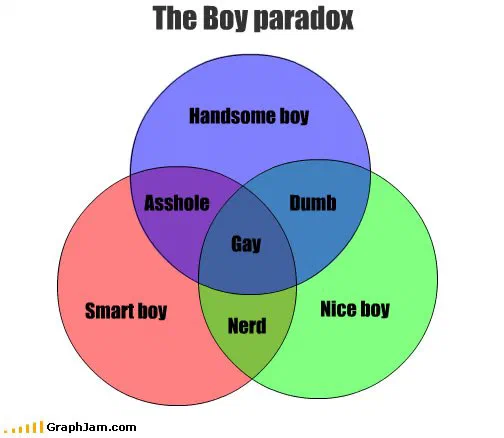
Three circles, handsome, smart, nice, correctly overlapped so all seven regions exist, and every region labelled. The pairwise overlaps get one-word verdicts, one of which is an insult the archive does not reproduce here. The central region, where all three conditions hold at once, is filled with a sexual orientation.
Three circles. Handsome boy. Smart boy. Nice boy. Every one of the seven regions a three-set Venn diagram contains is filled in.
The pairwise overlaps get one-word verdicts, a man who is handsome and smart but not nice receives an insult, one who is handsome and nice but not smart is dismissed as stupid, one who is smart and nice but not handsome is filed as a nerd. The archive describes those rather than transcribing them.
The central region, where all three hold at once, is filled with a sexual orientation.
The construction
Set aside the content for a moment, because the diagram is unusually well built.
A three-set Venn has seven regions and most joke versions label one. This one labels all seven, which means every pair of conditions has been thought about and every pair lands on a recognisable type. That is the same discipline as the archive’s Santa Claus diagram, and it is what separates a Venn diagram that classifies from a Venn diagram that just has a punchline in the middle.
It is also the correct rendering of a pick-any-two joke. Pick-any-two is a claim that all three pairwise intersections are non-empty and the triple intersection is not available, which is a statement about sets, and had been made in prose for decades without anybody drawing it.
The archive holds a second chart that makes the same claim about the same subject by different means: People you meet on the Web arranges three circles so that the triple intersection has no area at all. That version says the case is geometrically impossible. This one says the case exists and then disqualifies it, which is a weaker construction and a much more pointed one.
Both plates are set logic drawn out in full: three properties, seven regions, and a claim about which region is empty. The same reasoning applied to countable outcomes rather than adjectives is what the odds section is for.
The centre, and the reply
The centre is where the diagram stops being a set-theory joke and starts making a claim about people.
Assigning the all-three case to a sexual orientation does two things at once. It preserves the pick-any-two structure, the ideal partner is unavailable, and it locates the unavailability in somebody else’s identity rather than in the chooser’s expectations. That is a 2009 joke, told frequently, and it treats an entire population as a disqualifying condition.
It was answered in the same month, and the answer is in this plate’s link record. A gay men’s site linked the diagram under a headline asking why straight women are so deluded about the appeal of gay men, and put the question directly: is it safe to assume this was drawn by a heterosexual woman?
That is the population named in the centre replying to the chart on its own terms. The archive records both because both are the document.
Where it travelled
Five sites still link to it, and the spread is the widest of any plate in this collection.
Discover Magazine covered it, a science magazine engaging with a browser-drawn Venn diagram, which happened because the diagram is formally about set intersections. Les Inrocks, the French cultural weekly, included it in a web round-up with the note that a good old diagram was overdue. You Bent My Wookie posted it as The Boy Paradox Venn Diagram, crediting the source. The gay men’s site described above linked it critically. A Taiwanese forum posted the bare address.
Five domains, four languages of framing, one diagram, one month.
Which came first
The companion chart, The Girl Paradox, was published here on 3 September 2009, six days before this one.
Discover covered this chart first and then presented the other as its complement the following week, which is why several accounts have the order reversed. Both dates are in the archive and this plate keeps its own.
What the plate is worth now
Five sites still link to it, for an image containing about a dozen words.
The construction is excellent and the premise has not survived. What makes it worth publishing individually rather than folding into a collection is the pair of links: a science magazine treating it as a set-theoretic object, and the group named in its central region answering it in public within weeks. Both of those are what the chart is now for.