Nerd Love: Solve for i
Four lines of algebra whose answer is a sentence.
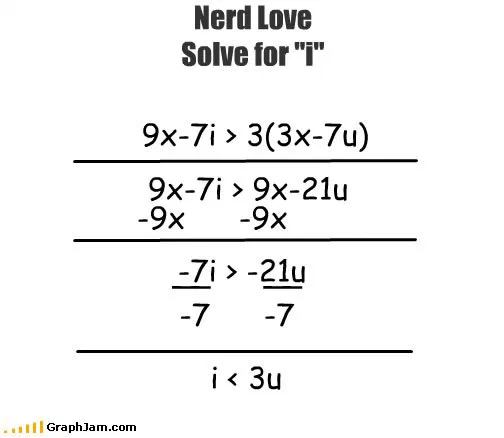
Four steps of school algebra, set out with the working shown and horizontal rules between stages. The x terms cancel, both sides are divided by a negative number, which is why the inequality flips, and the final line reads: i < 3u.
Four lines of algebra, laid out the way a school exercise book lays them out: the working shown, a horizontal rule between stages, the cancellations marked underneath. The heading says Solve for i.
The last line reads i < 3u.
Reading the answer
The joke is a pun that only exists in typed English, and it needs two separate conventions to work at once.
First, the sideways heart. Typing <3 to mean a heart is a keyboard workaround that
predates emoji, and by 2009 it was universal enough in online writing to be read
without effort. Second, the substitution of single letters for words — u for you,
which comes from text messaging and its character limits.
Put them together and the algebraic result reads as a sentence: i less-than-three u. I love you.
What makes the chart good rather than merely clever is that the setup is a genuine piece of mathematics whose answer happens to be that string.
The step that carries it
The working starts from an inequality containing three variables, expands the bracket
on the right, subtracts the 9x term from both sides so the x disappears, and then
divides through by −7.
That division is the whole engineering problem. Dividing an inequality by a negative
number reverses its direction: > becomes <. It is the rule most reliably forgotten
in school algebra, and here everything depends on it, because the pun requires
less-than and the previous line has greater-than.
Work the problem without the flip and you get i > 3u, which is not a heart and not a
sentence. Whoever built this started from the answer and constructed a problem that
would land on it, which means they had to choose a negative coefficient deliberately,
so that the flip would occur at exactly the right moment.
That is a piece of design, not a doodle.
That step, turning a feeling into a countable set, is the one move separating a joke chart from a probability that can be checked.
The genre it belongs to
This archive holds a small number of charts that do real work inside the joke: two plates on a conditional probability puzzle, and a probability argument about the size of a dating pool. Every one of them travelled further than the charts that only assert.
The reason is that a completed calculation can be checked, and something checkable gets forwarded with a claim attached — this is right — rather than merely enjoyed. A joke you can verify is a joke you can win an argument with.
Where it travelled
Four sites still link to it, and the spread is unusual.
A college hockey forum posted it inside a long-running thread, introduced simply as “a love note from Ralph”. Sustatu, a Basque-language technology site, described it as “beste demostrazio matematiko hau”, this other mathematical demonstration, while writing about whether real love could be proved. A French site listed it in a monthly round-up. Retrohelix ran it under the heading Nerdy mathematical love.
Four languages’ worth of framing, for an image whose only words are a two-line title.
The algebra needs no translation, <3 needs no translation, and the u substitution
had already crossed into text messaging in most of them.
What the plate is worth now
The <3 heart is now mostly a period detail: the emoji that replaced it arrived on
mobile keyboards within a few years of this chart being drawn, and a reader under
thirty may have to be told what the notation was for.
The algebra is unaffected. So is the construction: build a problem backwards from the answer you want, choose the coefficients so that the hardest rule in the topic is the one that delivers it, and show your working. Four sites still link to it, one hockey forum and one Basque technology site later, that construction is still the most efficient love note in this archive.