The Girl Paradox
The same construction as its companion, with the centre pointed at her judgement rather than at somebody else's identity.
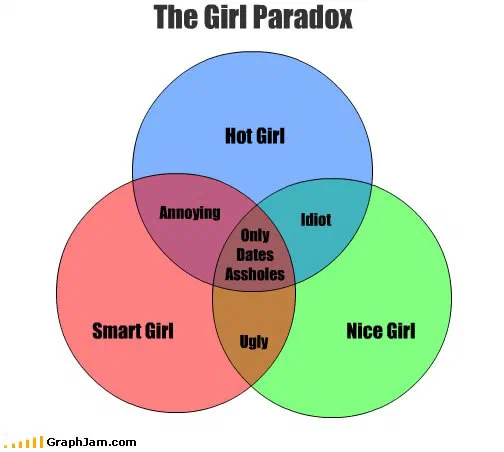
Three circles, hot, smart, nice, correctly overlapped so that all seven regions exist, and every region labelled. The pairwise overlaps get one-word dismissals, described here rather than quoted. The central region, where all three conditions hold, is filled not with a disqualification of her but with a verdict on the men she chooses.
Three circles. Hot girl. Smart girl. Nice girl. All seven regions of the diagram are filled in.
The pairwise overlaps carry one-word dismissals, a woman who is hot and smart but not nice is called difficult, one who is hot and nice but not smart is called stupid, one who is smart and nice but not hot is dismissed on her appearance. The archive describes those rather than transcribing them.
The centre, where all three hold, is not a disqualification of her. It is a verdict about the men she chooses.
The one difference from its companion
These two plates are the same diagram twice, and comparing them is more useful than reading either alone.
The structure is identical: three desirable properties, all seven regions labelled, every pairwise overlap landing on a recognisable dismissal, and the pick-any-two logic that says the ideal case is not available. Both are competently built and both label every region, which is rarer than it should be.
What differs is where the centre puts the fault.
The boy version disqualifies the all-three case by assigning it a sexual orientation, the ideal man exists but is unavailable to the person reading. This version leaves her fully qualified and available, and relocates the problem to her judgement. She is not the thing that is wrong; her choices are.
That is a materially different joke, and the asymmetry is the most interesting thing about the pair. One says the ideal is out of reach. The other says the ideal is reachable and is choosing badly, which is a complaint about her rather than about the population.
A pick-any-two claim is a statement about which combinations are available, which is the same kind of statement the odds of a game make — with the difference that a wheel’s combinations can be counted and a dating pool’s cannot.
Why the pair got covered by a science magazine
Discover Magazine wrote about both, which is an unusual outcome for two browser-drawn diagrams about dating.
The reason is the form. A pick-any-two claim is a statement about which intersections in a three-set system are occupied and which are empty, and that is a proper set-theoretic assertion however unserious its content. Fill in all seven regions and you have made the claim explicit and checkable: here is what each pair produces, here is what all three produce, here is why the combination you want does not arrive.
The archive’s People you meet on the Web makes the same claim by geometry instead, arranging three circles so the triple intersection has no area at all. Read those three plates together and you have a small, accidental study of how many ways one folk argument can be diagrammed.
The register, and how this is published
The labels in this diagram are unkind in a specific 2009 way, the pairwise regions run through appearance, intelligence and temperament as though each were a disqualifying axis, and the centre is crude.
The image is published unaltered because it is the artefact, and the labels are described rather than quoted. That is the same handling this archive applies to its companion plate, to the workshop flowchart and to the internet-hell diagram: the document is not edited, and the transcription is not performed.
Where it travelled
Five sites still link to it.
Discover Magazine covered it as the complement to the other chart, noting the pairing explicitly. FamousDC picked it up with a hat-tip to the person who sent it in. A Taiwanese forum posted the bare address. Abalook wrote a short post about it and told readers to use a direct link to reach the diagram at the source, which is a small piece of evidence that the source was already becoming hard to navigate. And it was pasted into a game-development IRC channel the day after publication.
What the plate is worth now
Five sites still link to it, for an image whose text is three circle labels and the verdicts in its regions.
It is published individually rather than as a collection entry for two reasons: the link profile, and the comparison. Set beside its companion, it turns a pair of unkind 2009 jokes into a document about how differently the same construction gets pointed depending on who is being described.