Where a Philosophy Degree Gets You in Real Life
A pie chart with two slices that are the same slice, which is either lazy or the best joke in the collection.
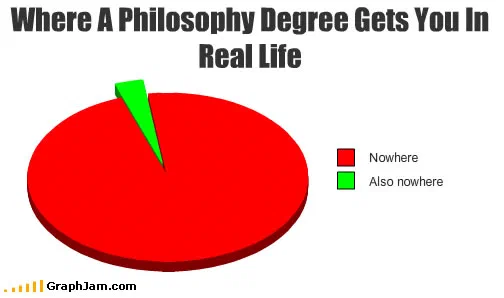
Two slices, in the builder’s red and green. The legend distinguishes them: the large one is Nowhere and the sliver is Also nowhere. The distinction the chart draws is between two identical destinations.
A pie chart with two slices. The large red one is labelled Nowhere. The thin green one is labelled Also nowhere.
That is the whole image, and its quality depends entirely on whether you think the second category is a mistake.
The division is the joke
It is not a mistake. It is the best decision on the chart.
A pie chart with one slice, and this archive has several, says: your question has exactly one answer, and here it is, occupying everything. That is a strong move, and it is the move this chart declines to make.
Instead it divides the circle, sets up a legend that promises a distinction, and then puts the same destination on both sides of it. The reader’s eye does the sequence: two slices, so two outcomes, so read the legend, so — oh.
What that construction adds is effort. A single-slice pie is a shrug. A two-slice pie whose categories are identical is somebody who sat down, opened a chart builder, entered two values, typed two labels, and produced a distinction with nothing on either side of it. The chart is about futility and it enacts futility, which is more than most of the archive manages.
Why this particular degree
The joke is not really about philosophy. It is about a specific kind of conversation that every humanities student has had, in which somebody asks what the degree is for and the question is not being asked in good faith.
Philosophy attracts it more than most subjects because its output is not a skill with a name. An engineering graduate can say what they can do. A philosophy graduate has to explain what argument structure is worth, to somebody who has already decided.
Which is why the chart travelled the way it did, not among people mocking philosophy, but among people studying it.
Where it travelled
Three sites still link to it, and one of them is the ideal venue.
The Student Room is a very large British forum used by school leavers choosing courses and by undergraduates halfway through them. Somebody linked this chart inside a thread titled What can you do with a philosophy degree?, a genuine careers question, asked by somebody deciding, answered in part with a pie chart saying nowhere twice.
That is the chart being used exactly as designed, by the audience it was drawn about, in the conversation that produced it.
MyConfinedSpace reposted it under its full title. A German-English blog picked it up with the site’s own tag as the anchor.
The correction the chart deserves
For the record, because the archive should not let an assertion stand unchallenged just because it is drawn in red: the premise is not true.
Philosophy graduates do comparatively well. They score highly on the admissions tests for law and business postgraduate study, and they place respectably on graduate schemes, for the same reason the joke exists, the degree is training in the structure of arguments, which is not a named skill and is broadly useful.
None of which makes the chart worse. A joke does not have to be right, and this one is funnier for being wrong in a way its own audience knew it was wrong.
What the plate is worth now
Three sites still link to it, the strongest of them a careers thread on a student forum, for an image containing eleven words.
Its companion in this archive is What you can do with a music degree, which makes the same joke about a different subject, and the school and study collection holds several more charts about the distance between a syllabus and a salary. This is the sharpest of them, because it is the only one that bothers to draw a distinction it has no intention of honouring.