People You Meet on the Web
Three sets, three pairwise overlaps, and no triple intersection at all. The joke is a property of the geometry.
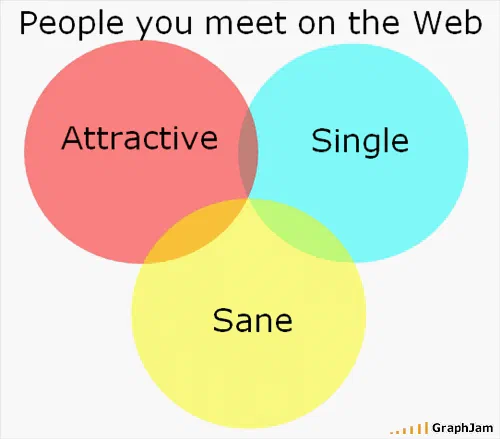
Three circles of equal size, labelled attractive, single and sane. Every pair overlaps. But the three are placed so that their boundaries converge on one point rather than enclosing an area, so the region where all three conditions hold has zero size.
Three circles of equal size. Red is attractive. Cyan is single. Yellow is sane.
Every pair overlaps. But the three are positioned so that their boundaries converge on a single point in the middle, and the region where all three would hold at once has no area.
The empty triple intersection
A three-set Venn diagram has seven regions: three singles, three pairwise overlaps, and the one in the middle where everything is true at once. That seventh region is what a three-circle Venn is for, it is the only reason to draw three circles rather than three separate lists.
This diagram removes it. Not by leaving it blank, and not by writing something in it, but by positioning the circles so that it does not exist as a region at all. Three arcs meet at a point. A point has no area, so nothing can be in it.
That is a genuinely elegant move, and it is a different joke from the one this archive usually makes with three circles. The other three-set diagrams here label the centre — Santa Claus in one, a punchline in another. This one makes the centre geometrically unavailable and lets the reader discover that by looking for it.
Somebody noticed at the time
Charts in this archive were usually forwarded for their subject. The link data shows this one being forwarded for its construction.
A Brazilian blog that reposted it in December 2008 added the note observe a ausência de intersecção no gráfico — note the absence of an intersection in the graph. That is a reader in 2008 identifying exactly the property described above, in a language the chart contains none of, and pointing it out to their own readers as the thing worth seeing.
It is the clearest evidence in this archive that the audience was reading these as diagrams and not only as jokes.
The three properties
The choice of sets is doing work as well. Attractive, single and sane are not three arbitrary qualities — they are the three conditions in a standing joke about dating pools that predates the internet entirely, usually delivered as a pick-any-two.
Rendering pick-any-two as a Venn diagram is the correct translation, because pick-any-two is a statement about pairwise intersections being non-empty and the triple intersection being empty. The joke was always set-theoretic; nobody had drawn it.
Where it travelled
Three sites still link to it, and the strongest is the least likely.
The Adam Smith Institute, a British free-market think tank, closed one of its daily blog reviews with it, under the heading “And finally”, with the sentence: yes, this is the internet. A think tank’s daily link round-up is not where any of the charts in this archive expected to end up.
A Brazilian accountancy blog reposted it with the geometric observation quoted above. A Swedish personal blog linked the bare address.
Why it is filed under Life Online
The subject is the internet rather than dating, which is what the title says and what the Adam Smith Institute’s one-line introduction confirms. The claim is not that the three properties are rare in general, it is that they do not co-occur in the population you meet through a screen.
That reading dates the chart in a specific way. In November 2008 the idea that online acquaintance was a distinct and lower-quality channel was still a commonplace; the assumption that everybody you know arrived through one had not yet happened.
What the plate is worth now
Three sites still link to it, an image containing four words.
Its argument about the internet has been overtaken by the internet. Its geometry has not: three circles converging on a point, with the region everybody looks for reduced to nothing, remains the most economical way anyone has drawn an impossibility.