Why People Write "First" in the Comments
Three circles, each inside the last, and the outermost one is the verdict.
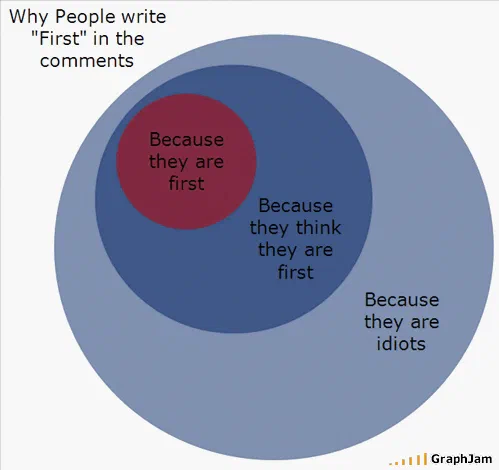
Three nested sets. Every commenter who is first is also a commenter who thinks they are first, and both groups sit entirely inside the third and largest circle.
Three circles, one inside another. The innermost and smallest, in red, is “because they are first”. Around it, “because they think they are first”. Around both, filling the frame, “because they are idiots”. Nothing overlaps partially. Each set is wholly contained by the next.
The containment is the argument
A pie chart would have divided first-posters into three groups and let you weigh them against each other. This diagram refuses to do that. It says the categories are not alternatives at all: they are nested, and the largest one has no exceptions inside it.
Read it carefully and the structure is doing something a bar chart could not. Being genuinely first, the one case where the behaviour has any claim to legitimacy, is drawn as the smallest region on the page, and it is still inside the verdict. There is no escape hatch. The diagram grants the premise, grants the rare correct case, and then closes the circle around it anyway.
The middle ring is the observation that gives the whole thing its accuracy. Most people who write “first” are wrong about being first, because a comment form does not know what happened while you were typing. That is a real property of the software, not an insult, and the chart puts it in the middle where it belongs.
Formally this is an Euler diagram rather than a Venn diagram, a distinction that gets flattened constantly online. A Venn diagram shows all possible intersections whether or not they are populated. An Euler diagram shows only the relationships that actually hold, which is why nested circles are the correct choice here and why the plate reads as cleanly as it does.
Where it travelled
Slate reached for it while reporting on the business behind the meme sites. In a piece on Pet Holdings, the company that ran I Can Has Cheezburger, FailBlog and GraphJam, the chart appears as an example of what the network’s audience made: graphs about the dangers of Snuggies, and about why people write “first” in web comment threads. That is a rare case of a plate being cited as evidence of a business model rather than as a joke.
Elsewhere it went where the annoyance was. A chess.com forum thread about being first on the daily puzzle. A City of Heroes forum. Reddit, from where a mirror still survives. The Hungarian blog Webisztán discussed it under elsőzés, the local word for the practice, and quibbled with the verdict. Les Inrocks in France ran it in a web round-up, glossing the behaviour as writing “preums”. The Czech site Root.cz filed it in a software round-up dated 21 January 2009. The Chinese site Jiandan hosted a discussion titled, in translation, “why does everybody like to grab the sofa”, which is what claiming first is called there.
Five languages, four different local names for the same habit, one diagram that needed no translation because its argument is made of geometry.
What the plate is worth now
The behaviour has largely gone. Comment sections closed, moved to platforms that sort by engagement, or disappeared into feeds where being first is meaningless. The diagram outlived its target.
What keeps it in the archive is that the form is genuinely well chosen. It is the only plate here that would work as a teaching example: this is what set containment looks like, this is why nesting is not the same as a Venn diagram, this is how an argument gets made by arrangement rather than by area. Ten domains still point at this address, several from conversations that ran for years after the chart was drawn.