Problem Solving Flowsheet
A flowchart with one terminal state, reachable from everywhere, including the paths that solve nothing.
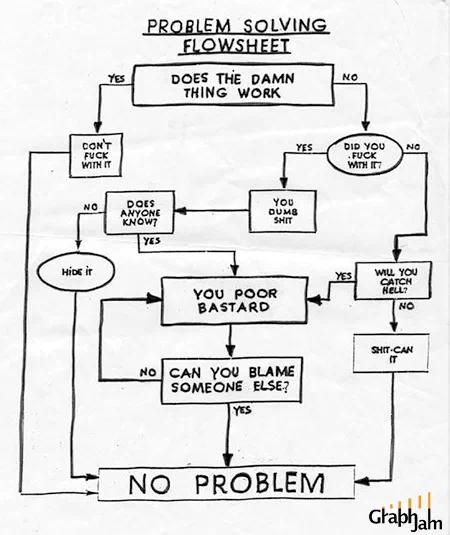
Hand-drawn on creased paper and photographed rather than scanned. The entry question is whether the thing works. From there the branches ask whether it was interfered with, whether anyone knows, whether there will be consequences, and whether somebody else can be blamed, and every route, including hiding it and discarding it, ends at one box: NO PROBLEM. The wording throughout is unprintable workshop English.
A sheet of paper, creased where it was folded, photographed rather than scanned. Across the top, hand-lettered and underlined: Problem Solving Flowsheet.
The entry condition is a yes-or-no question about whether the thing works. From there the branches ask whether it was interfered with, whether anyone knows, whether there will be consequences, and whether somebody else can be blamed. There is a route that hides it and a route that discards it.
Every one of those routes arrives at the same box at the bottom of the page: NO PROBLEM.
The wording throughout is unprintable, this is the register of something pinned above a lathe, not something circulated to a manager, and it is described here rather than quoted. The image is published as it was found.
Why it is a real flowchart
This is the entry in the archive most likely to be dismissed as not a chart at all, and it is one of the few that is formally rigorous.
It has a single entry point. Every decision node has exactly two labelled exits. There are no dangling branches and no unreachable nodes. It has one terminal state. Those are the actual requirements of a decision diagram, and a great many flowcharts drawn in earnest by professionals fail at least one of them.
What it does with that rigour is the joke. A correctly constructed flowchart whose terminal state is reachable from every path is a machine that cannot fail, because failure has no representation in it. The diagram is not badly drawn. It is perfectly drawn around a conclusion that was fixed before the first question was asked.
That is a criticism of a whole genre of corporate process documentation, made in about 1975, in pencil.
A flowchart earns the name when every branch terminates. The most-used chart of that kind in a casino is the basic-strategy matrix, which is a decision procedure for one hand of blackjack with no branch left dangling.
Its actual age
This chart is not original to 2008 or to this site, and it would be misleading to present it as such. Versions of it have been on workshop walls for decades, propagating by photocopy, with the wording drifting between generations and the layout staying recognisably the same. Some copies label it a flowchart, some a flowsheet, and this one uses the older word.
What this address holds is one photographed instance of a piece of folk documentation older than the web, which makes it the only genuinely found object in the archive, as opposed to the 650 charts that were drawn for it.
Why it was published on 1 April
The date is presumably not accidental, and the record says nothing about it either way.
Where it travelled
Three sites still link to it, and the strongest is the one that matters.
An answer on Stack Overflow cited this address as its source, in a thread about examples of factorial time complexity. Whatever the reasoning was, the archive does not preserve the answer body, only the link, the result is that a high-authority programming reference points at a photograph of a workshop poster hosted on a chart humour site. A Spanish-language mirror of the same thread carries the same link, which is how those mirrors work.
The third is a blog post filed under a French idiom, using the chart as a punchline.
What the plate is worth now
Three sites still link to it, and, unusually for this archive, a link from a site that programmers consult daily rather than one they read for entertainment.
The chart’s argument has outlived every technology it was drawn about. Any decision procedure whose terminal state is reachable from all inputs is decoration, and a flowchart is the only format that shows this at a glance, which is why the diagram has survived forty years of photocopying and one migration onto the web.