Che Guevara T-Shirts vs the People Who Wear Them
The rare chart that got linked approvingly from both ends of a political argument.
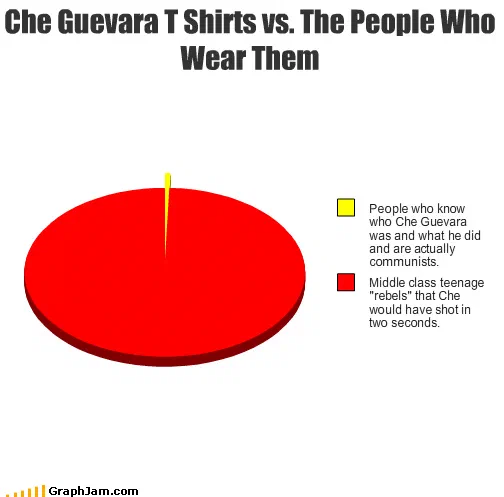
Two categories, and the legend text is longer than most charts here have in total. The yellow sliver is people who know who the man was, know what he did, and hold the politics. The red remainder, effectively the entire circle, is middle-class teenage rebels who, the legend says, Che would have shot in two seconds.
Two categories. A yellow sliver: people who know who the man was, know what he did, and actually hold the politics. And the rest of the circle, in red: middle-class teenage rebels whom, the legend says, he would have had no time for whatsoever.
The legend text is longer than the entire content of most charts in this archive.
Why the long legend is the right call
Almost every chart here keeps its labels short, because a sliver-and-remainder pie works fastest when the reader can take both categories in at a glance. This one does the opposite and it is correct to.
The argument requires three conditions to be stated for the small category, knowing who he was, knowing what he did, and holding the politics, because dropping any one of them weakens it. Somebody who knows the name is not the same as somebody who knows the history, and somebody who knows the history is not the same as somebody who agrees with it. The sliver is only a sliver if all three have to be true at once.
That is a set intersection expressed in prose because the format has no room for a three-circle Venn. It is the least elegant solution on the page and the only one that carries the claim.
What the chart is actually about
Not politics, or not primarily. It is about the distance between an image and its content, and specifically about one photograph that became one of the most reproduced pictures of the twentieth century, detached from any of its circumstances, printed on merchandise sold at volume.
That detachment has been written about at length by historians of the image and by the photographer’s own estate, which spent years pursuing commercial uses of it. The chart is not making an original observation; it is stating an old one in two legend entries, which is what this archive was for.
The archive files it with clothing rather than with politics for the same reason. The subject is what people wear and what they think it says about them, and that is a chart about signalling.
The two readings, and why both got links
This is one of very few charts in the archive that was linked approvingly from opposite directions within a week, and the reason is that it declines to say which argument it is making.
Read from the left, it is a complaint about a serious politics being reduced to merchandise by people who have not read any of it, a criticism made continuously by the left itself for fifty years.
Read from the right, it is a chart about a man whose record the wearers are ignorant of, and the sting is in what he would have done to them.
The legend supports both. Nothing on the image adjudicates, and the chart was drawn by somebody the site recorded as an unknown source, so there is no author’s position to appeal to either.
Where it travelled
Three sites still link to it, and the split is the interesting part.
Les Inrocks, the French cultural magazine, broadly of the left, included it in Revue du web #79, describing it as “la vérité sur les tee Che Guevara”, the truth about Che T-shirts. Free Republic, a conservative American forum, posted it the next day, 27 April 2010, filed under a keyword page about the man. Blame It On The Voices, a humour blog, reproduced it under its full title.
A French cultural weekly and an American conservative forum agreeing about a pie chart, one day apart, is the whole story of this plate.
What the plate is worth now
Three sites still link to it, for an image whose text runs to about forty words.
The shirt is still on sale and the photograph is still detached from its history, so the chart has not dated. What has changed is that the mechanism it describes, an image circulating with its content stripped off, stopped being a curiosity about merchandise and became the ordinary condition of images generally.