Reasons People Hate Twilight
A chart about how an opinion is acquired, in which almost nobody acquired it from the work.
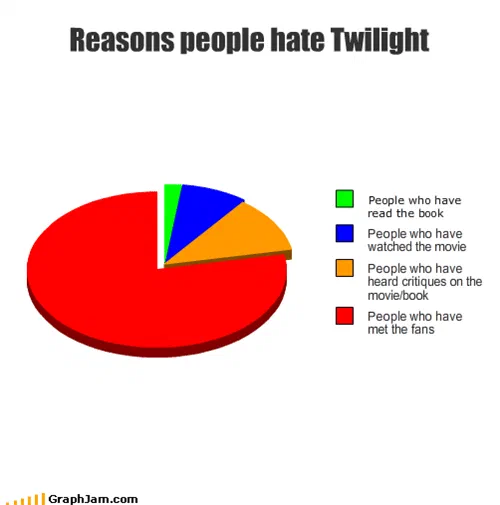
Four nested categories on one axis, ordered smallest to largest. The chart never states which of the four it agrees with, and that is what let both sides of the argument repost it.
Four categories, ordered by size. People who have read the book: a thin green sliver. People who have watched the film: slightly larger. People who have heard critiques of it: larger again. And the red remainder, about three quarters of the circle: people who have met the fans.
The ladder that runs the wrong way
The four categories are not arbitrary and they are not in a random order. They form a descending sequence of directness, read the primary work, watch the adaptation, hear somebody else’s assessment, meet the audience, and the slices get bigger as the contact with the actual work gets thinner.
That inversion is the entire argument, and it is the same device as the archive’s chart of credence by source, where the bars grow as the evidence weakens. Set up an ordered axis of quality and let the quantities run against it, and the chart makes its point without a word of commentary.
What it claims is not that the work is bad. It claims that the opinion is almost never first-hand, which is a statement about how cultural judgements get transmitted rather than about the object being judged.
Why it reads two ways
The chart declines to resolve, and that is the whole of its design.
Read as a criticism of the backlash, it says: three quarters of the people with an opinion have not read the book, and their objection is social rather than literary. That is a defence.
Read as a criticism of the fandom, it says: the audience was so trying that meeting it was sufficient grounds. That is an attack.
Nothing on the image chooses. The categories are neutral descriptions of routes to an opinion and the reader supplies the verdict, which is a harder thing to draw than a position. What the three recorded citations show is not two camps arguing but the chart travelling sideways, a game community’s log and two Spanish-language blogs, none of them taking a side on the books at all.
The date
14 January 2009, which places it precisely. The first film had been released in November 2008 and was still in cinemas; the second book had been out since 2006 and the second film was in production.
So this was drawn at the point where the backlash had become larger than the audience for the work itself, and the chart’s largest category, meeting the fans, was a live phenomenon rather than a retrospective observation. That timing is what makes it a document rather than a joke about a franchise.
Where it travelled
Three sites still link to it, and two of them are Spanish.
A Spanish-language film blog reproduced it as razones por las que la gente odia Crepúsculo, crediting a reader who had passed it on. A second Spanish site used it in a post about the fandom rather than the films. And it was pasted into the IRC channel log of a game community in March 2009, with the URL including a fragment pointing at the comments — somebody was linking not just the chart but the argument underneath it.
That last detail is worth noting. Almost every link in this archive points at the chart. This one points at the discussion.
What the plate is worth now
Three sites still link to it, an image containing about twenty-five words.
Its subject has resolved: the franchise concluded, the backlash exhausted itself, and the critical reassessment that follows every mass-market phenomenon aimed at teenage girls has since happened. What survives is the construction, four routes to an opinion, ordered by directness, with the shares running the other way, and a reminder that in January 2009 the largest reason for holding a view about a book was having met somebody who liked it.