What You Can Do To Elvis
Not a chart. A permissions table, and the song was already one.
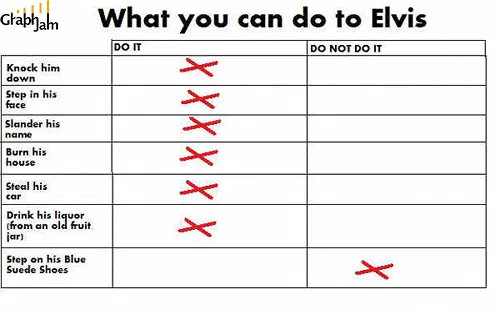
Two columns, do it and do not do it, and seven rows taken in order from one lyric. Six of the seven actions are permitted. The seventh, and the only prohibition, concerns a pair of shoes.
A two-column table. The columns are headed do it and do not do it. Eight rows, taken in order from one verse.
Knock him down. Step in his face. Slander his name. Burn his house. Steal his car. Drink his liquor from an old fruit jar. All six are marked in the left column.
The seventh row is about a pair of shoes, and it is the only mark in the right column.
Not a chart, and that is the point
This archive is mostly pie charts. This is a permissions matrix, the format an access-control list or a house-rules poster uses, and it is here because the song it transcribes was already one.
The lyric of Blue Suede Shoes has an unusual structure for a rock and roll record. It is not a narrative and not really a boast. It is an enumerated list of tolerated actions followed by a single exception, which is the exact logical shape of a permissive policy with one deny rule at the end.
Nothing had to be transformed to make this table. The song supplied the rows, the two states and the ordering. What the drawer did was notice.
The escalation is structural
Read the left column downwards. Assault, humiliation, defamation, arson, grand theft, and finally the appropriation of a drink.
Written as a sentence, the disproportion between that list and the one prohibition is a joke that has to be set up and delivered. Drawn as a table, it is simply visible: seven marks in one column, one mark in the other, and the reader’s eye runs down the rows and arrives at footwear.
That is what a table does that prose cannot. It makes the comparison spatial, so the punchline does not need to be announced.
The fidelity
The rows follow the verse in sequence and stop where it stops. That matters more than it sounds.
A version that reordered the actions by severity would be a chart about escalation — tidier, and less accurate. A version that trimmed the list to three items would fit better and lose the accumulation. Keeping all eight, in the original order, including the parenthetical detail about the fruit jar, is the discipline that separates the good song charts in this archive from the ones that use a lyric as a prompt.
The fruit jar is the detail worth keeping. It is the only concrete noun in the list and the only one that dates the song.
Where it travelled
Three sites still link to it, and the first is the most useful placement any chart here achieved.
Wordnik, a dictionary and reference site, carried it on the page for the phrase blue suede shoes, in the community material attached to the entry, with the anchor text Do not do it. That means a person looking up what the phrase means encounters this table as part of the answer, which is a chart being used lexicographically.
A trivia site used it as its picture source in an article about the singer’s hair colour. And a Canadian forum hotlinked the image file itself, straight off the original host, one of the image URLs that now returns an error, and one of the image URLs that no longer resolves.
What the plate is worth now
Three sites still link to it, for a table with about thirty words in it.
Its lesson is the one the best entries in this archive keep teaching: the format is the joke. Somebody looked at a seventy-year-old song, recognised the logical structure of an access-control list, and drew it. No commentary, no exaggeration, no added categories, and the result is funnier than anything that could have been written about the song instead.