Things People Say When I Write With My Left Hand
A frequency table of one conversation, held several thousand times.
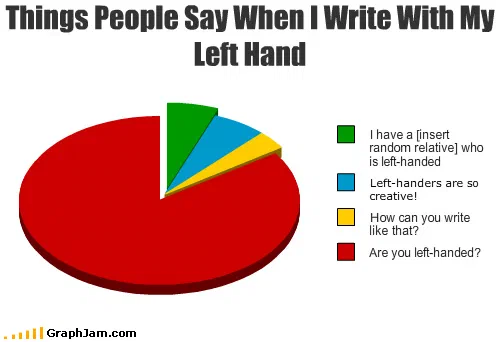
Four categories, ranked. Three quarters of the pie is the question are you left-handed, asked of somebody visibly writing with their left hand. The remaining quarter divides between a compliment about creativity, a question about the mechanics, and a mention of a relative — with the relative’s identity left as a fill-in-the-blank.
Four remarks, in one pie, ranked. The largest slice, about three quarters of the circle, is the question are you left-handed?, asked of somebody who is at that moment writing with their left hand.
The remaining quarter divides between a compliment about creativity, a question about how it is physically managed, and the mention of a relative, with the relative left as a fill-in-the-blank.
The dominant slice, and why it is the finding
A question whose answer is already visible to the asker is not a question. It is a remark wearing the grammar of one.
That is what this chart records, and it is a real observation about how conversation works. The sentence is not requesting information, the information is on the page. It is a way of noticing something out loud, which is a different speech act with a different function: it opens an exchange rather than closing a gap.
The chart’s method is to put that remark on the same axis as three genuine remarks and let the proportion make the point. If the interaction were mostly enquiry, the slices would be more even. They are not.
The bracketed relative
One legend entry is written as a template with a slot in it rather than as a sentence: a reference to some randomly specified left-handed relative.
That is the most precise thing on the chart. The identity of the relative varies with every telling, a mother, a cousin, a grandfather, and the structure of the sentence never varies at all. Recording the specific relative would have been recording noise. Recording the slot is recording the pattern.
Very few charts in this archive show that kind of discipline about what to abstract. Most would have picked one relative and lost the generalisation.
Why it belongs with the speech charts
This archive holds a whole collection of charts whose dataset is a sentence somebody actually said: what people yell when they hurt themselves, what a phrase like no offence actually predicts, what gets said in the seconds before an accident, the responses a person behind a counter hears several hundred times.
They are all the same kind of observation, a scripted exchange, counted, and they are all drawn by people in a position to count. This one is drawn by somebody who has been on the receiving end of the same four sentences since primary school.
Handedness is only the trigger. The subject is the script.
Where it travelled
Three sites still link to it, and one of them is the highest-authority link on any chart in this collection.
The writer Matthew Dicks posted it under a headline stating that left-handed people would confirm it could not be more true. His site exists at two addresses, a Squarespace address and his own domain, and the export records both, which is why one chart appears to have two links from the same writer. The stronger of the two is a strong domain.
A German community forum linked the raw address inside a thread. That is the whole profile: one writer with a large readership, and one forum.
What the plate is worth now
Three sites still link to it, an image containing about thirty words, drawn in a browser in February 2010.
The chart has not dated, which is unusual here. The four sentences it records are still the four sentences, in the same proportions, and the dominant slice is still a question whose answer is sitting in front of the person asking it. That is the sort of finding that only an amateur chart ever bothers to write down.