Suggested Process of Interacting with Ms. Spears
A chorus with conditionals in it, drawn as the flowchart it always was, and shipped with a disclaimer about the age of its data.
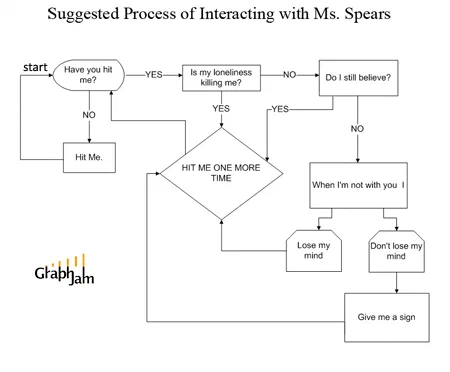
A start arrow, one decision diamond and eight boxes, taken in order from one chorus. The first decision asks whether the subject has been hit; the no branch instructs that she be. The central diamond restates the title line. Two mutually exclusive outcomes about the state of the singer’s mind converge on a request for a sign, which loops back to the beginning.
A start arrow. A decision diamond asking whether the subject has been hit. The no branch leads to a box instructing that she be. The yes branch runs on through further decisions, about loneliness, about belief, to a central diamond that restates the song’s title line.
Two outcome boxes about the state of the singer’s mind converge on a final box requesting a sign, and that box loops back to the beginning.
The lyric was already a process
The chorus of …Baby One More Time is unusually procedural for a pop record. It contains a conditional, a state that gets tested, an imperative and a request that returns the process to its starting condition. Written out as prose it reads as anguish; written out as a diagram it reads as a specification with a cycle in it.
That is what makes this a good chart rather than a lyric with boxes drawn round it. Every element on the page corresponds to something the song actually supplies, in the order the song supplies it, and the drawer added no steps.
The archive’s other song-as-diagram plate, a calendar filled in from a Cure lyric, works the same way, and the two together make the argument this collection keeps making: some lyrics are already data structures, and the only creative act available is recognising which structure.
The loop
The last box returns to the first decision. There is no terminal state.
A flowchart without an exit is the archive’s other recurring joke, the workshop poster elsewhere in this collection runs every path into a single box marked no problem, which achieves the same thing from the opposite direction. Here the process simply never resolves, which is a fair reading of the song and a fair reading of the situation the song describes.
It is also the structural feature that makes the diagram funnier than the lyric. A listener experiences a chorus as a repeat. A reader of a flowchart sees the return arrow and understands immediately that the process cannot terminate.
The dated-data warning
The original post carried a caveat: that the chart was dated 1999, and that some aspects might no longer apply.
That is the earliest piece of editorial voice in the recovered archive, from within the site’s first three weeks, and it is doing something quite specific. Marking a dataset with its collection date and warning that conditions may have changed is a real convention from technical and statistical publishing. Applying it to a pop single from nine years earlier is a joke about the apparatus rather than about the singer.
The site would go on to publish six hundred more charts, and a great many of them borrow that apparatus — figure numbers, projected values, methodological hedges in titles. This is where that habit starts.
Where it travelled
Three sites still link to it, and the profile is thin: an h2g2 message-centre thread, a small blog filing it under flow charts, and a forum post in a thread whose title complains about the volume of chart images then circulating.
That last one is worth keeping for what it records. In March 2008 somebody was already complaining that graphs had become the new cat pictures. This site was three weeks old.
What the plate is worth now
Three sites still link to it, a diagram of nine shapes.
Its value to the archive is chronological. It is the earliest flowchart here, it carries the first instance of the site’s borrowed-apparatus voice, and it demonstrates on day nineteen the thing the collection would spend two and a half years proving: that the format is the joke, and that finding a lyric with conditionals in it is most of the work.